Foldable Containers Cut Construction Transport Emissions by 75%
The Hidden Carbon Cost of Getting Containers to Site
Construction transport accounts for somewhere between 2.4% and 5.5% of a project's total CO2 emissions, depending on the study you read. On urban projects with long supply chains, project-level audits have put that figure closer to 10%. That may sound modest next to the embodied carbon of concrete or steel, but it is one of the few emission categories a site manager can cut dramatically with a single procurement decision.
The arithmetic is simple. A standard rigid container, whether a 20-foot storage unit or a site office module, occupies one full truck load. If you need ten units for a site office setup, you schedule ten deliveries. A loaded articulated HGV in Europe emits roughly 0.8 to 1.0 kg of CO2 per kilometre. Over a 150 km delivery from depot to site, each truck produces around 135 to 150 kg of CO2 in one direction. Multiply by ten trucks, add the return legs, and you are looking at approximately 2.7 tonnes of CO2 before a single person has sat down at a desk.
Every one of those trips also means a heavy vehicle navigating urban roads, queuing at site gates, waiting for crane availability, and occupying road space during restricted hours. In cities with low-emission zones, such as London's ULEZ, Paris's ZFE, Berlin's Umweltzone, or Zurich's own heavy vehicle restrictions, each additional truck movement adds a compliance headache on top of the environmental cost.
The 10:1 Ratio and What It Means in Practice
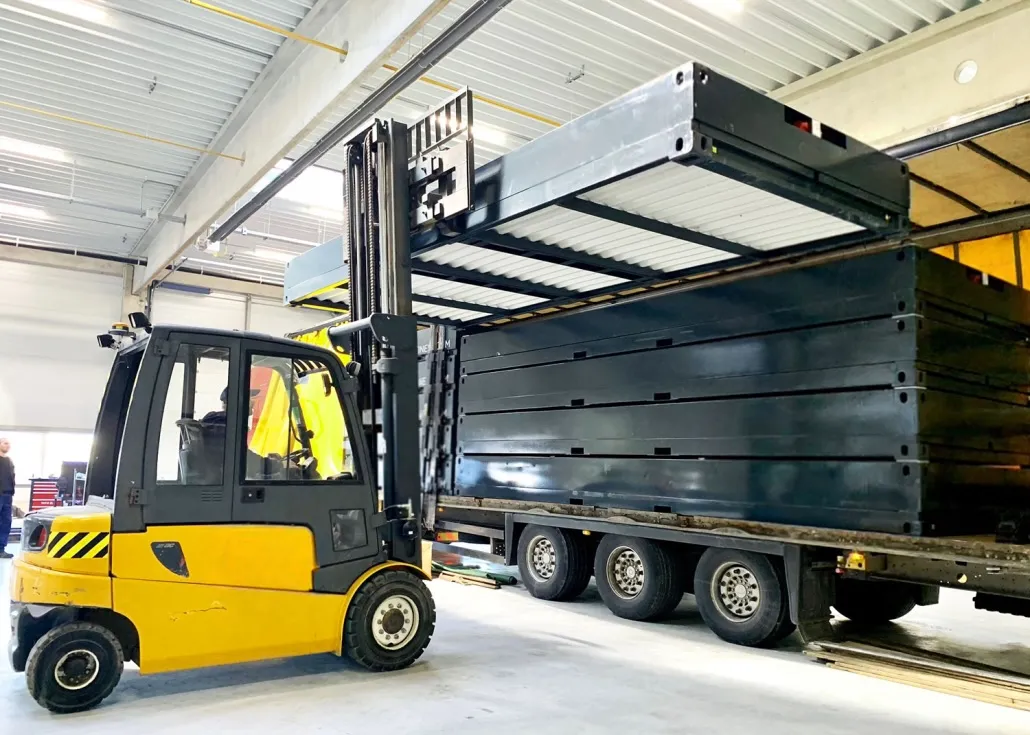
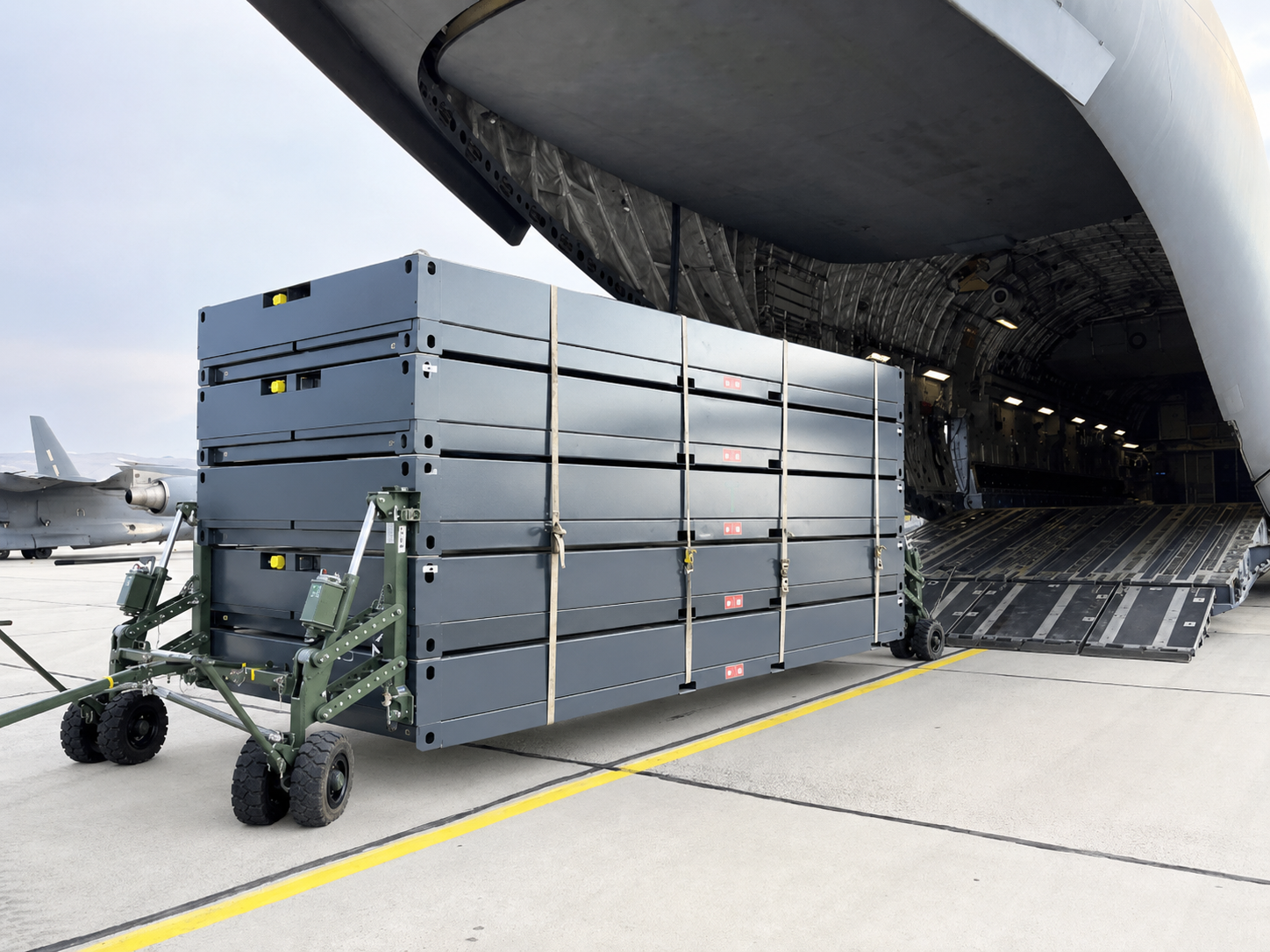
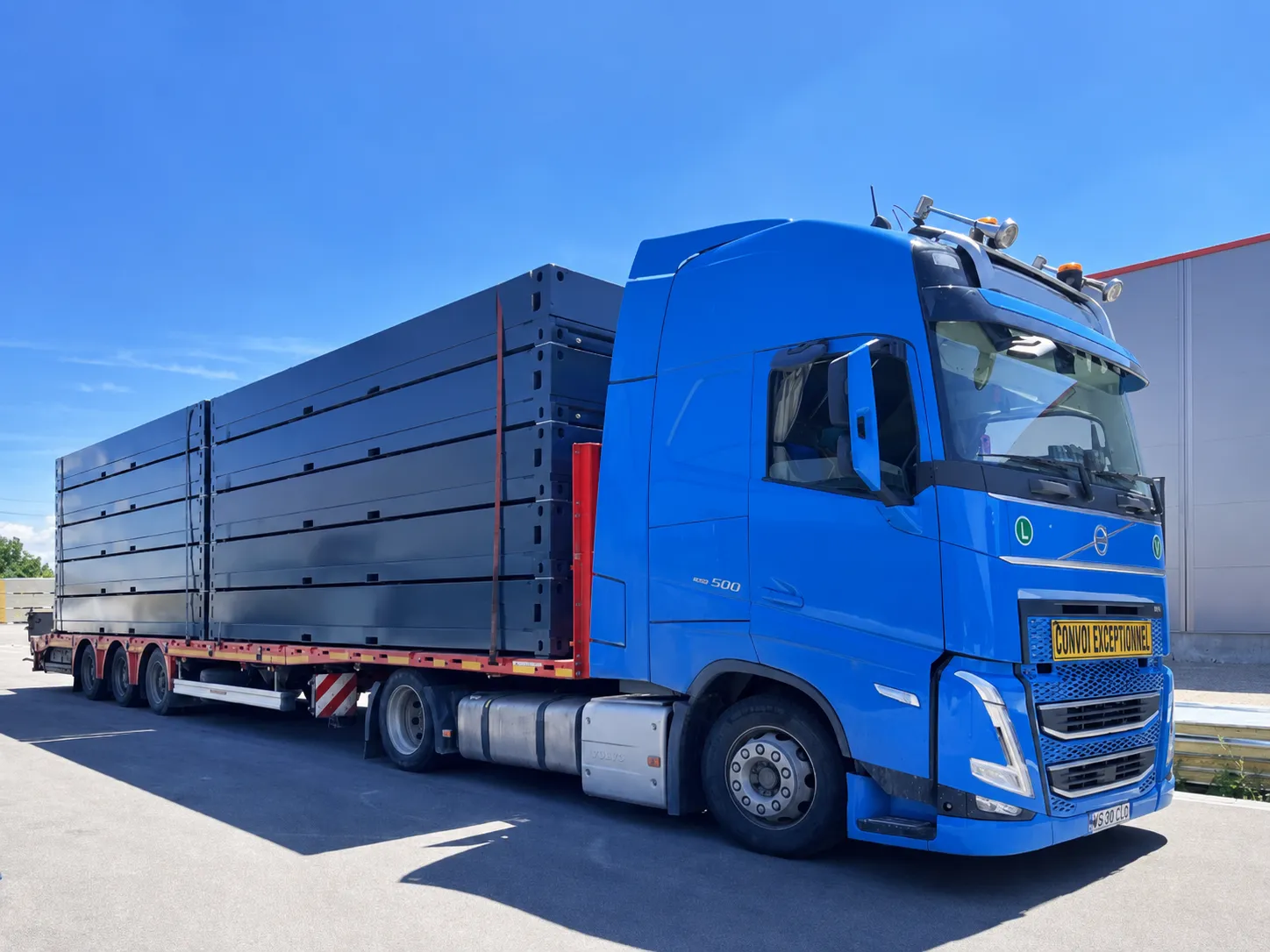
Foldable containers collapse to approximately 20% of their erected volume. That single fact changes construction logistics fundamentally. Instead of one container per truck, you load up to ten foldable units onto a single vehicle.
For the same ten-unit site office, you replace ten deliveries with one. One truck, one driver, one slot at the site gate, one crane lift sequence. The same ratio applies in reverse: when you demobilise the site, one truck collects all ten units instead of ten separate pickups. Over a full mobilisation and demobilisation cycle, you have reduced your delivery-related truck movements from twenty to two.
Where the 75% figure comes from
If you run the pure maths on a 10:1 consolidation, the CO2 saving on transport is closer to 90%. The headline figure of up to 75% is more conservative, and deliberately so. A truck carrying ten collapsed containers is heavier than one carrying a single unit, which increases fuel consumption per kilometre. Real-world logistics also involve partial loads, repositioning between depots, and variable distances. The 75% figure accounts for these variables. It is a defensible number you can use in reporting, not a best-case laboratory figure.
A worked example you can adapt
Take a concrete scenario: ten containers for a construction site office in Zurich, sourced from a depot 150 km away.
Standard rigid containers: 10 trucks, each travelling 150 km loaded and 150 km empty on return. Total distance: 3,000 km. At an average emission factor of 0.9 kg CO2 per kilometre (loaded average, accounting for empty return at lower weight), total emissions come to roughly 2,700 kg CO2.
Foldable containers: 1 truck, 150 km loaded and 150 km return. Total distance: 300 km. Even with a heavier load increasing the per-kilometre emission rate slightly, total emissions sit at roughly 300 to 350 kg CO2.
Saving: approximately 2.3 to 2.4 tonnes of CO2 per mobilisation cycle. Double it if you count the demobilisation trip at project end. On a multi-phase project where containers relocate between zones, the saving multiplies with each move.
The variables you need to plug in for your own project are straightforward: number of units, one-way distance from depot to site, and the emission factor for the vehicle class. For Scope 3 reporting purposes, the relevant emission factors are published by the European Environment Agency or, in Switzerland, by BAFU. The GHG Protocol places these emissions in Scope 3, Category 4: Upstream Transportation and Distribution.
Beyond Transport: The Wider Emissions Picture
The CO2 saving on truck journeys is the most measurable benefit, but it is not the only one.
Crane and on-site equipment time
Unloading ten rigid containers typically requires a mobile crane on site for most of a working day. Each hour of crane operation burns diesel and generates emissions. With foldable containers arriving on a single truck, the unloading and erection sequence is compressed. Foldable units are designed to deploy in minutes with minimal heavy equipment. Less crane hire time means less fuel burned on site.
Storage between projects
Between deployments, rigid containers sit in yards at full volume. Foldable units stack flat, so more units occupy less depot space. A storage yard that holds 50 rigid containers in a given footprint can hold several hundred foldable units. This is not just a space-planning convenience. Depot facilities consume energy for security, lighting, and access. Fewer square metres per unit stored means a lower energy overhead per container over its lifetime.
Reusability and embodied carbon
Any container has embodied carbon from its manufacture. The longer and more frequently a unit is reused, the more that embodied carbon is amortised across projects. Foldable containers, because they are cheaper and easier to transport, tend to see higher reuse rates. A unit that serves eight projects distributes its manufacturing footprint across eight clients rather than sitting idle because the cost of moving it was too high.
Disruption to surrounding communities
This is harder to quantify in CO2 terms but matters operationally. Fewer truck deliveries mean less noise, less dust, fewer temporary road closures, and less congestion around the site. On urban construction projects, community disruption is a planning condition and a reputational risk. Reducing delivery trips from ten to one is a tangible point in your logistics management plan.
Construction Site Use Cases for Foldable Containers
Foldable containers are not limited to a single application on site. The most common construction site deployments include:
- Site offices and meeting rooms for project management teams, including multi-storey configurations where units stack on prepared foundations
- Welfare and break facilities for construction crews, fitted with heating, lighting, and basic kitchen provisions
- Secure tool and material storage during build phases, with lockable steel construction
- Temporary sanitary facilities, which can be paired with dedicated sanitary container systems for showers, toilets, and accessible bathroom provision
- Multi-phase projects where containers must physically relocate between zones or even between separate sites as work progresses, making the transport efficiency benefit cumulative
For construction projects with tight urban access, foldable containers also solve a practical geometry problem. A single truck delivering ten collapsed units requires one manoeuvre into a restricted site entrance rather than ten. On narrow city streets with limited turning circles, this can be the difference between a feasible delivery plan and one that requires traffic management orders and out-of-hours work.
Reporting the Saving: Scope 3, Tenders, and ESG Documentation
How this fits into Scope 3 reporting
The EU Corporate Sustainability Reporting Directive (CSRD), which applies to large companies and listed SMEs from the 2025 and 2026 reporting years, requires disclosure of Scope 3 emissions. Construction delivery transport falls squarely within Scope 3, Category 4 of the GHG Protocol. If your firm is subject to CSRD, or supplies firms that are, you will need to quantify and report these emissions. A documented reduction of 75% on container delivery transport is a concrete, auditable line item.
For the calculation methodology, EN 15978 provides the European standard for assessing environmental performance of buildings across their lifecycle, including transport modules A4 (transport to site) and C2 (transport for end-of-life processing). ISO 14064 covers the broader framework for quantifying and reporting greenhouse gas emissions. If your project or organisation uses either standard, the delivery data from foldable container logistics slots directly into the relevant modules.
Why this matters in tender scoring
Public procurement in Switzerland, under the revised BoeB/LMP framework, increasingly incorporates sustainability criteria. In the EU, the trend is the same. Construction firms that can document lower transport emissions, with actual figures rather than vague commitments, score higher. A worked CO2 calculation showing a 75% reduction on site logistics transport is exactly the kind of specific, verifiable evidence that tender evaluators look for.
This is not a theoretical future requirement. Major public clients, including Swiss municipal and cantonal authorities, are already requesting carbon performance data as part of tender submissions.
What is the difference between CO2 and CO2e?
You will see both terms in reporting frameworks. CO2 refers to carbon dioxide alone. CO2e, or carbon dioxide equivalent, is a broader measure that converts the warming effect of all greenhouse gases (methane, nitrous oxide, fluorinated gases, and others) into a single figure expressed as an equivalent amount of CO2. For construction transport, the dominant emission is CO2 from diesel combustion, so the two figures are close. But for formal Scope 3 reporting, you should use CO2e, as it captures the small additional contributions from other gases in engine exhaust. eCO2 is simply another notation for the same concept.
Foldable vs. Rigid Containers on Construction Sites
The practical differences on a construction project are worth spelling out directly.
On transport efficiency, the ratio is 10:1 for foldable units compared to 1:1 for rigid containers. One truck replaces ten.
On setup speed, foldable containers are designed to erect in minutes on site with minimal equipment. Rigid containers require crane placement, which depends on crane availability, ground conditions, and weather windows.
On storage between projects, foldable units stack flat at roughly 20% volume. Rigid units occupy their full footprint in the yard regardless of whether they are in use.
On CO2 per delivery cycle, foldable containers deliver a reduction of up to 75% on transport emissions for equivalent site capacity.
On suitability for tight urban sites, fewer and smaller delivery operations reduce the logistical burden of access restrictions, turning circles, and low-emission zone compliance.
One concern site managers sometimes raise is whether a collapsible container can match the structural integrity and interior finish of a rigid unit. Foldable containers are engineered as steel-framed, lockable, weather-resistant structures. They are not temporary in the sense of being flimsy. The folding mechanism is a transport and storage feature, not a structural compromise.
Making the Switch: What You Need to Plan For
If you are considering foldable containers for your next project, the practical planning points are straightforward.
Ground preparation is the same as for any modular unit: a level, load-bearing surface, typically compacted hardcore or concrete pads. Connection points for power, water, and data should be pre-planned based on the site layout, just as they would be for rigid containers.
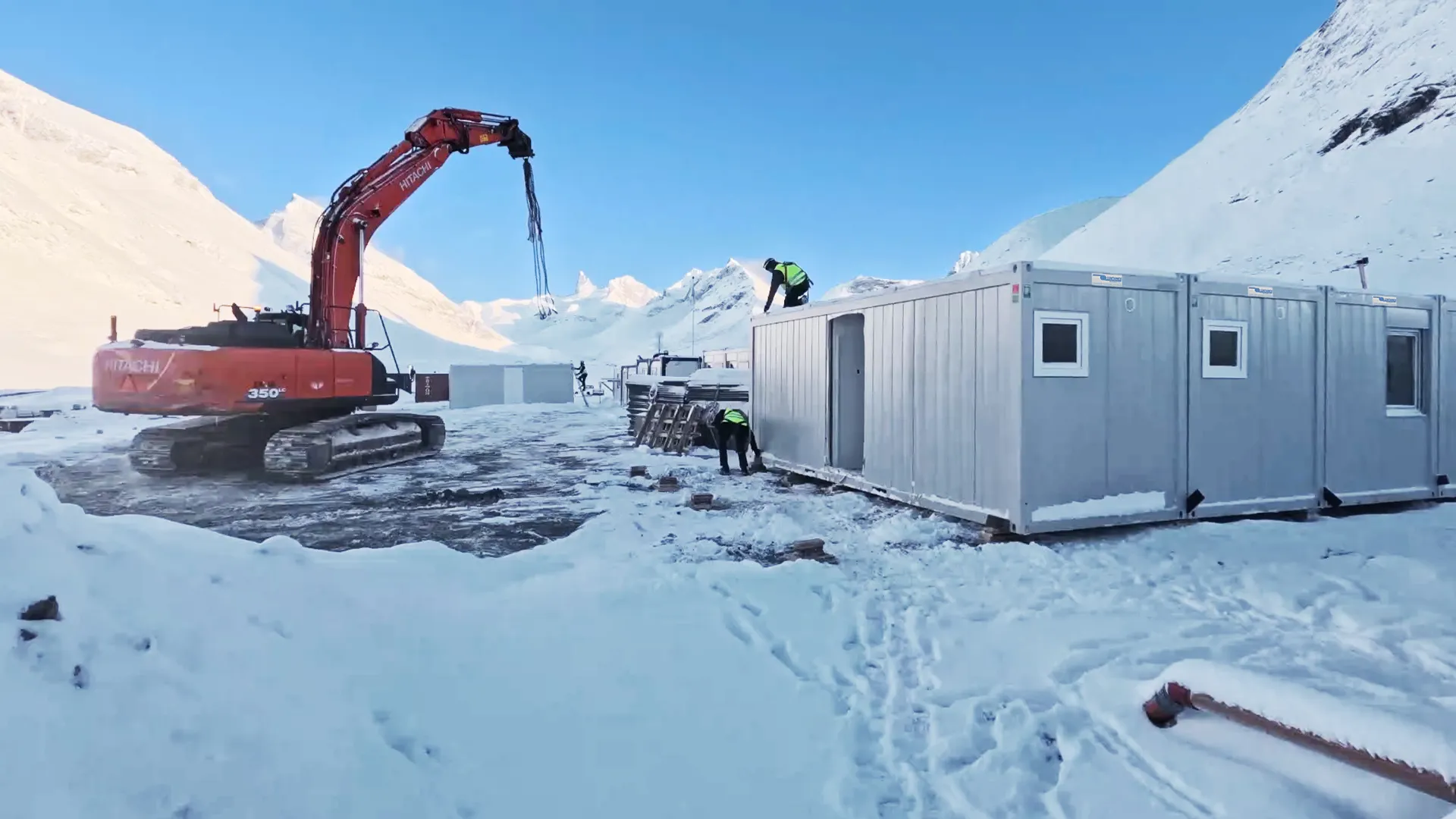
Deployment requires fewer resources than rigid units. You do not need a large mobile crane on standby for an entire day. Erection is a manual process aided by the container's own hydraulic or mechanical folding system, depending on the model.
For multi-phase projects, the ability to collapse, relocate, and re-erect units within the same site is a genuine operational advantage. You avoid the cost and emissions of sending containers back to a depot and redelivering them to a new zone.
Phasing is worth thinking through at the planning stage. If your project has distinct construction phases with different welfare or office requirements, foldable containers let you scale up and down without the overhead of multiple full-truck deliveries each time.
HEPF coordinates modular infrastructure projects from requirement through to installed facility, helping you select and configure the right system for your site. For construction projects, that means matching the correct product line to each use case, whether that is foldable site offices, sanitary provision, cold storage, or a combination, and managing the delivery logistics as a single coordinated operation rather than a series of separate container bookings.
How much CO2 do we need to reduce by 2030?
Under the Paris Agreement, global emissions need to fall by roughly 43% from 2019 levels by 2030 to stay on track for 1.5 degrees of warming. Switzerland's own targets under the revised CO2 Act aim for net-zero by 2050, with interim reduction milestones. For the construction sector specifically, transport emissions are one of the most accessible levers. You cannot easily change the embodied carbon of concrete on a project-by-project basis, but you can change how many trucks you send to deliver your site infrastructure. A 75% reduction on container delivery transport is a measurable contribution to both project-level and corporate-level targets.


.webp)
Book a free consultation
Open, non-binding and tailored to your project.