From Field Kitchens to Forward Bases: Modular Military Infrastructure
The Operational Reality Driving the Shift
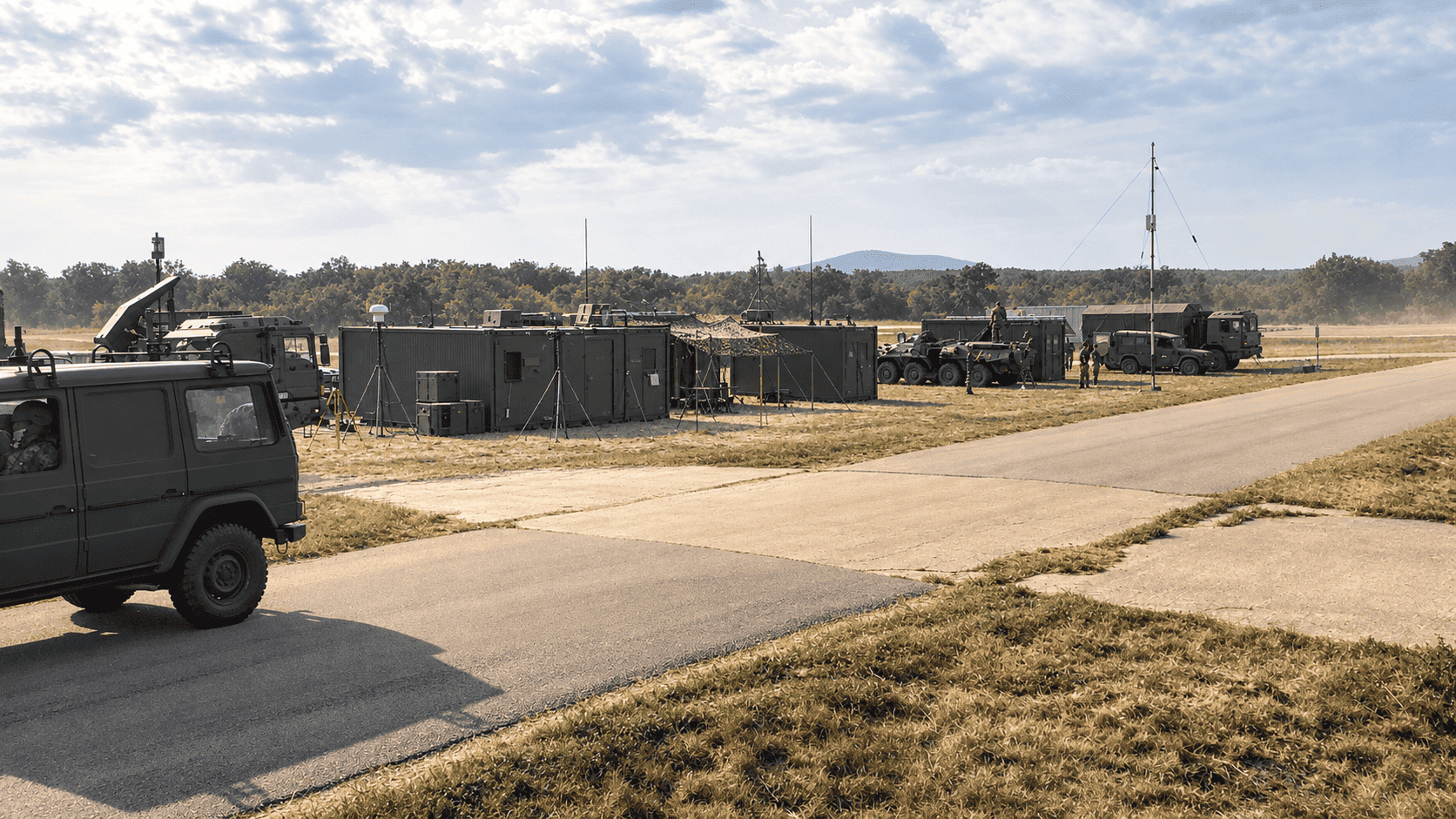
A military force receives orders to establish a functional base in a location with no existing infrastructure. The base needs accommodation for several hundred personnel, a medical facility, kitchens capable of feeding the force, command and office space, sanitation, storage, workshops, and power generation. It needs to be operational in days, not months. And when the mission ends or the force reposition, the entire facility must be recoverable and redeployable elsewhere.
This is not a hypothetical scenario. It is the standing requirement behind NATO's military mobility initiatives and the EU Military Mobility Action Plan 2.0, adopted in November 2022, which specifically targets the ability of forces and their supporting infrastructure to move across allied territory at operational speed. The alliance's Steadfast Defender exercises from 2024 onwards have tested exactly this kind of rapid infrastructure deployment at scale.
Defence organisations across Europe are responding by moving away from conventional construction and semi-permanent camps toward fully modular, relocatable facilities built from container-based systems. This article examines why that shift is happening, what a complete modular military facility actually consists of, how foldable container technology changes the logistics calculation, and what defence procurement teams should evaluate when selecting a modular infrastructure partner.
The Logistics Problem Traditional Construction Cannot Solve
Conventional military construction, whether concrete, steel-frame, or semi-permanent prefabricated structures, requires months of lead time. It demands heavy plant, skilled trades on-site, local material supply chains, and permitting processes. In forward or expeditionary environments, none of these can be guaranteed. Even in established theatres, the lead time from requirement to occupancy routinely stretches beyond the operational timeline.
The U.S. Army's experience illustrates the problem clearly. Congressional testimony and Government Accountability Office reports on military construction (MILCON) programmes have documented a backlog running into tens of billions of dollars in deferred maintenance and delayed projects. Cost overruns and schedule slippage are structural, not exceptional. The U.S. Army Corps of Engineers has begun pivoting toward prefabricated and modular construction for MILCON reform precisely because traditional methods cannot deliver at the speed and cost the force requires.
European armed forces face the same pressure, compounded by the NATO mobility requirement. With multiple member states now spending well above the 2% GDP defence target, and Baltic and Eastern European nations investing heavily in forward infrastructure, the volume of new military facilities needed is growing faster than conventional construction can deliver.
There is a further problem that is less often discussed: recovery. Semi-permanent camps built with conventional methods become fixtures. Dismantling them is as expensive and slow as building them, so they persist long after the operational need has passed, consuming maintenance budgets and occupying land. The infrastructure becomes a liability rather than an asset.
The real constraint, then, is not building a structure. It is moving infrastructure to where it is needed, setting it up with minimal manpower, operating it for the duration of the mission, and recovering it cost-effectively when the mission changes.
What a Complete Modular Military Facility Actually Looks Like
A forward operating base or training camp is not a single container. It is an integrated site comprising multiple functional zones, each with distinct technical requirements.
Functional zones in a typical military facility
- Accommodation: sleeping quarters with insulation, heating or cooling, privacy partitioning, and lighting. Force size determines the number of modules and the density of configuration.
- Command and offices: workspace for planning, communications, and administration. May require signals protection depending on classification level.
- Medical: triage, treatment, diagnostics, and inpatient care. Clinical zoning, HVAC with filtration, and compliance with medical infrastructure standards (STANAG 2506 provides NATO medical support guidelines) are essential.
- Kitchen and catering: professional kitchen technology with ventilation, water supply, electrical integration, and food storage. Field kitchens must feed hundreds of personnel per meal cycle reliably.
- Sanitation: toilets, showers, and changing facilities, including barrier-free accessible units. Fresh-water and waste-water systems must be self-contained or connectable to field utilities.
- Storage: secure, weather-resistant storage for equipment, ammunition, supplies, and spare parts.
- Cold storage: refrigerated units for food logistics, medical supplies, or other temperature-sensitive materiel.
- Specialist modules: shooting ranges, urban training environments, checkpoints, workshops.
- Power and utilities: generation, distribution, lighting, water treatment.
The planning challenge is at the site level, not the unit level. Access routes, utility runs, force protection measures, drainage, scalability for force size changes, and environmental protection (STANAG 4570 addresses environmental protection at military sites) all need to be resolved before a single module arrives.
Modular systems allow each function to be specified, configured, and delivered as a discrete module, then combined on-site into a coherent facility layout. But this only works if the modules are designed to integrate with each other and if someone has planned the site as a whole.
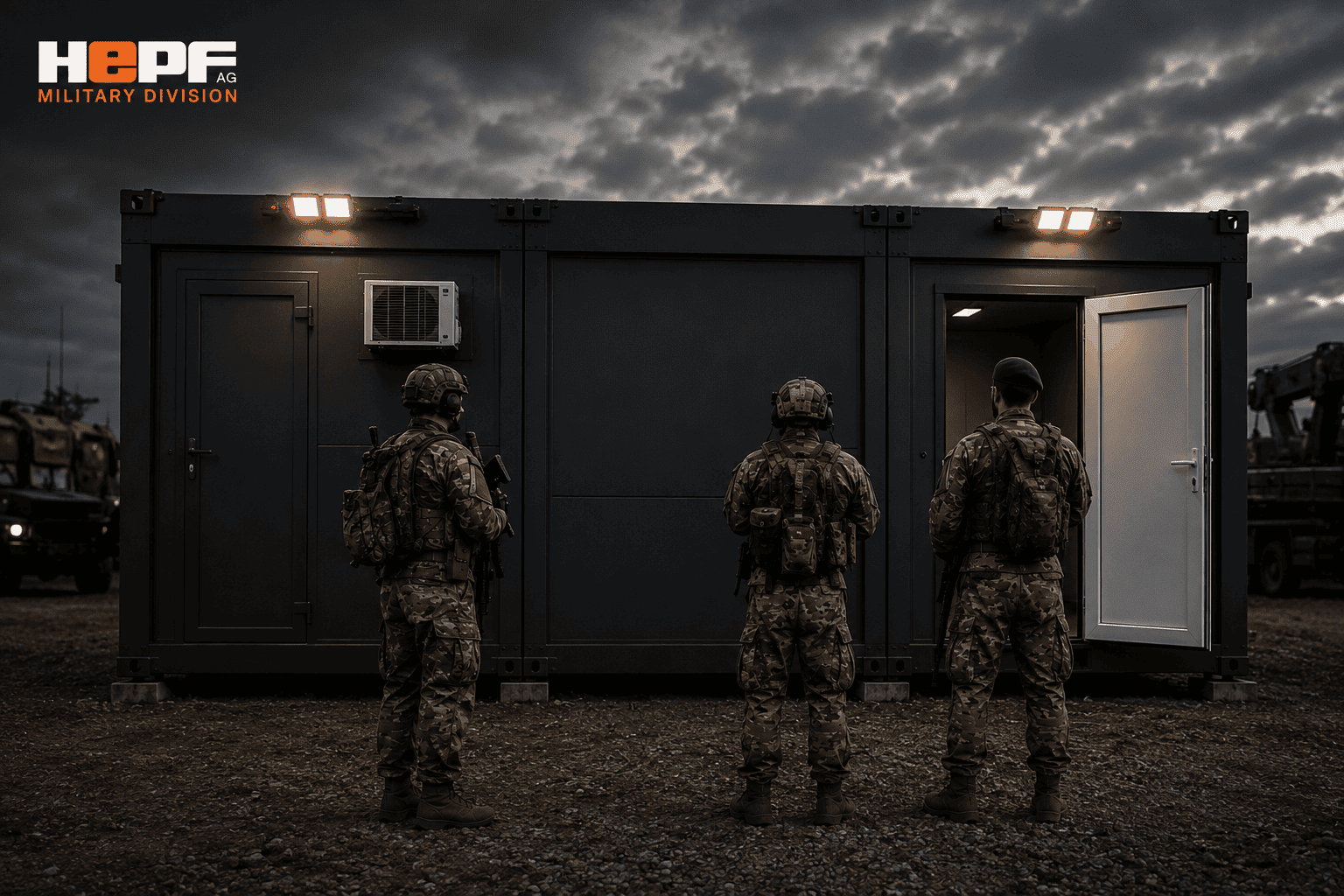
HEPF coordinates complete military site delivery across all of these functional zones. Accommodation and command modules draw on the Classic Line and Plus Line. Field kitchens are delivered with integrated professional kitchen technology, water, electrical, and ventilation systems as plug-and-play units. Deployable medical infrastructure covers triage, treatment, diagnostics, and inpatient care. The Sanitary Line provides toilets, showers, and barrier-free facilities. Storage and cold storage complete the facility. Configuration is matched to mission, climate, and force size.
Why Foldable Containers Change the Transport Equation
The single largest cost driver and operational constraint in military infrastructure deployment is transport volume. Moving assembled containers to theatre consumes trucks, aircraft sorties, and ship capacity. Moving them back consumes the same. Storing them between deployments consumes depot space.
A standard 20 ft ISO container (per ISO 668) has external dimensions of approximately 6,058 mm long, 2,438 mm wide, and 2,591 mm tall. It occupies its full volume whether loaded or empty. For a base requiring dozens or hundreds of containers, the transport bill is enormous.
The 1:5 ratio in practice
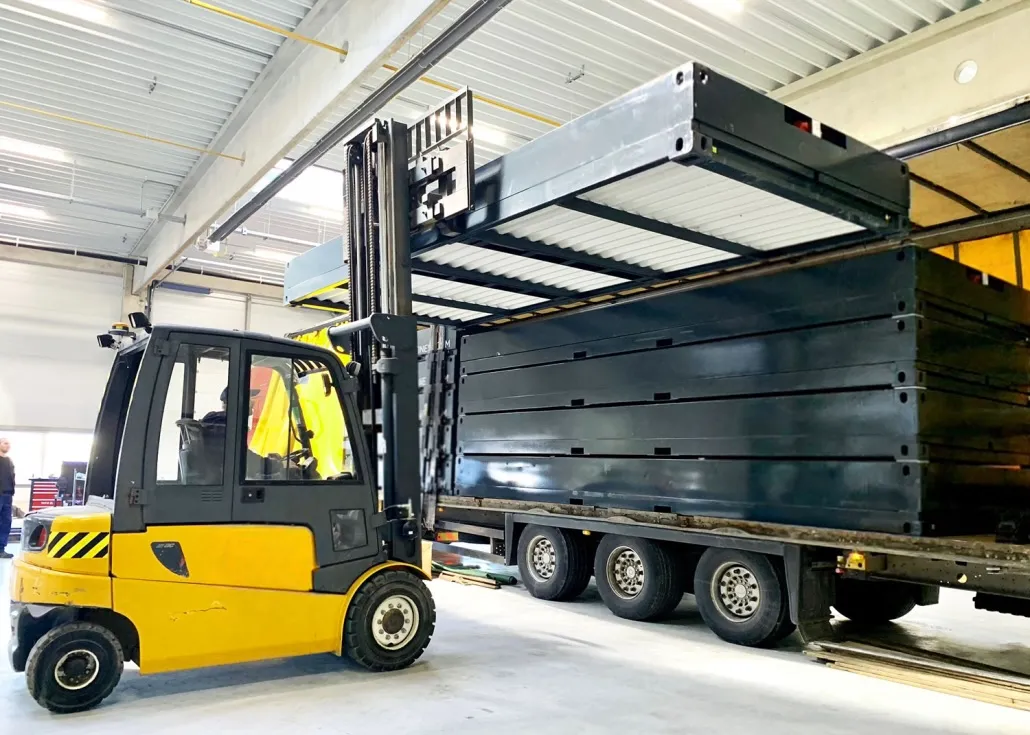
Foldable container technology changes this calculation fundamentally. A foldable 20 ft container that collapses to 518 mm in height achieves a 1:5 folding ratio: five folded units occupy the transport volume of one conventional rigid container.
This is not a marginal improvement. Consider a requirement for 50 container modules. With rigid containers, you need transport capacity for 50 full-height units. With foldable units, the same 50 modules require the transport volume of 10. That is 40 fewer truck movements per convoy, 40 fewer positions on a rail flat or ship deck, or the equivalent saving in aircraft sorties.
For air transport, the arithmetic is particularly consequential. A C-17 Globemaster III has a cargo hold volume of approximately 592 cubic metres and a payload capacity of roughly 77,500 kg. The number of rigid 20 ft containers it can carry is constrained by both volume and weight. Foldable units at one-fifth the height allow significantly more modules per sortie, and for lightweight aluminium-framed variants, the weight constraint eases as well.
Deployment and recovery speed
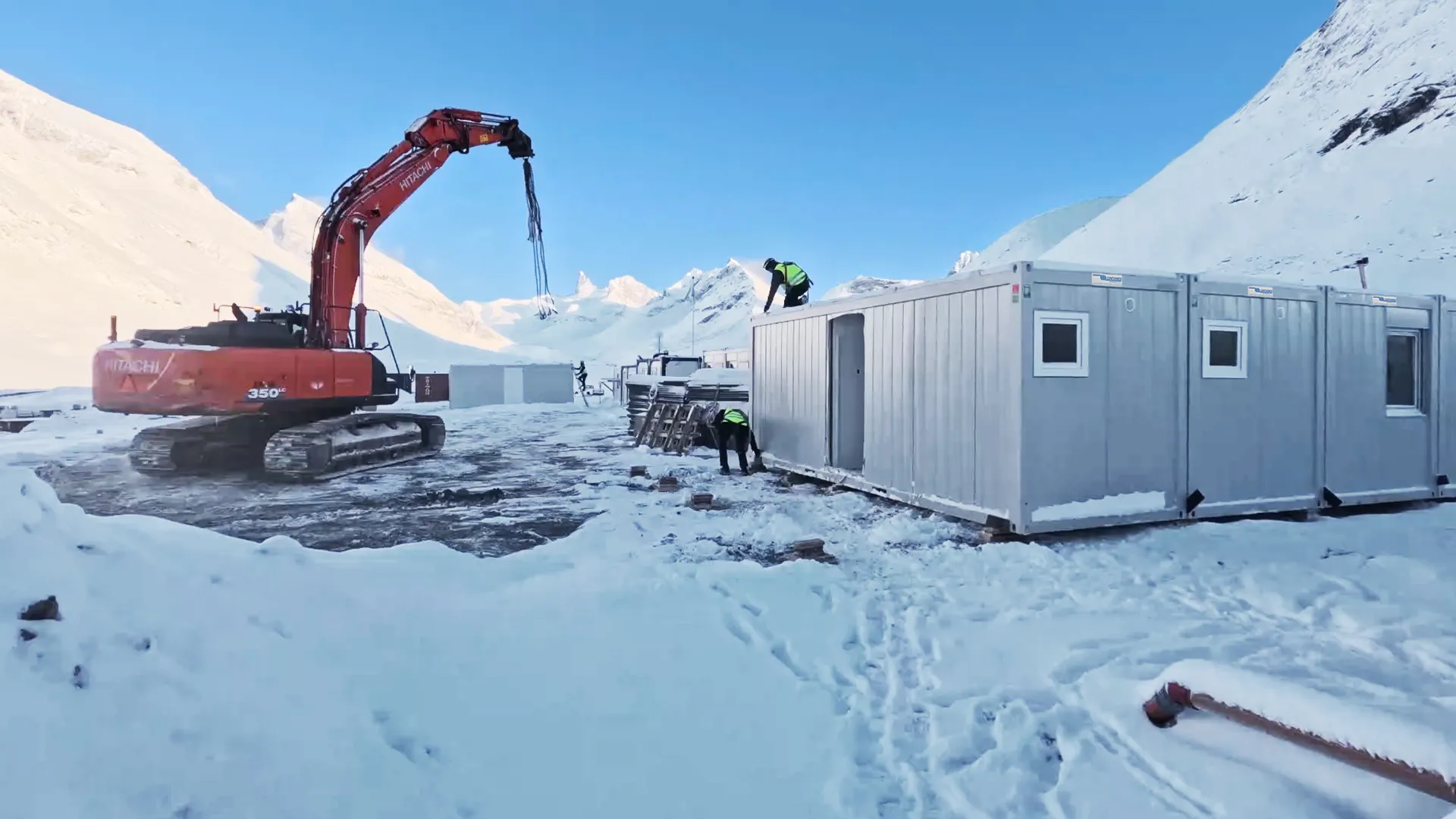
Foldable units are designed to unfold and fold using standard handling equipment (forklift, crane, or container handler) in approximately five to ten minutes per unit. No specialist tooling is required. This means a team with basic materials handling capability can erect a facility of several dozen modules within hours, not days.
On recovery, the same speed applies in reverse. The facility folds down, stacks, and ships out. This eliminates the "semi-permanent by default" problem that plagues conventional camps.
HEPF's FL Cargo foldable container operates as a full 20 ft cargo unit in the field with a 10,000 kg payload capacity, then folds to 518 mm height for return transport and storage. Corner castings are compatible with ISO 1161 standards for standard twist-lock handling and stacking. The Foldable Line is available in 10 ft and 20 ft platforms. Specialist variants include the FL Light (aluminium frame, air-transport capable for weight-sensitive deployments), the FL Ballistic Shield (modular ballistic protection that can be retrofitted to deployed units, with protection levels referenced to STANAG 4569 frameworks), and the FL Black Hole (acoustic and radio-electronic protection with integrated HVAC for signals-sensitive operations).
Permanent and Semi-Permanent Modular Buildings on Established Bases
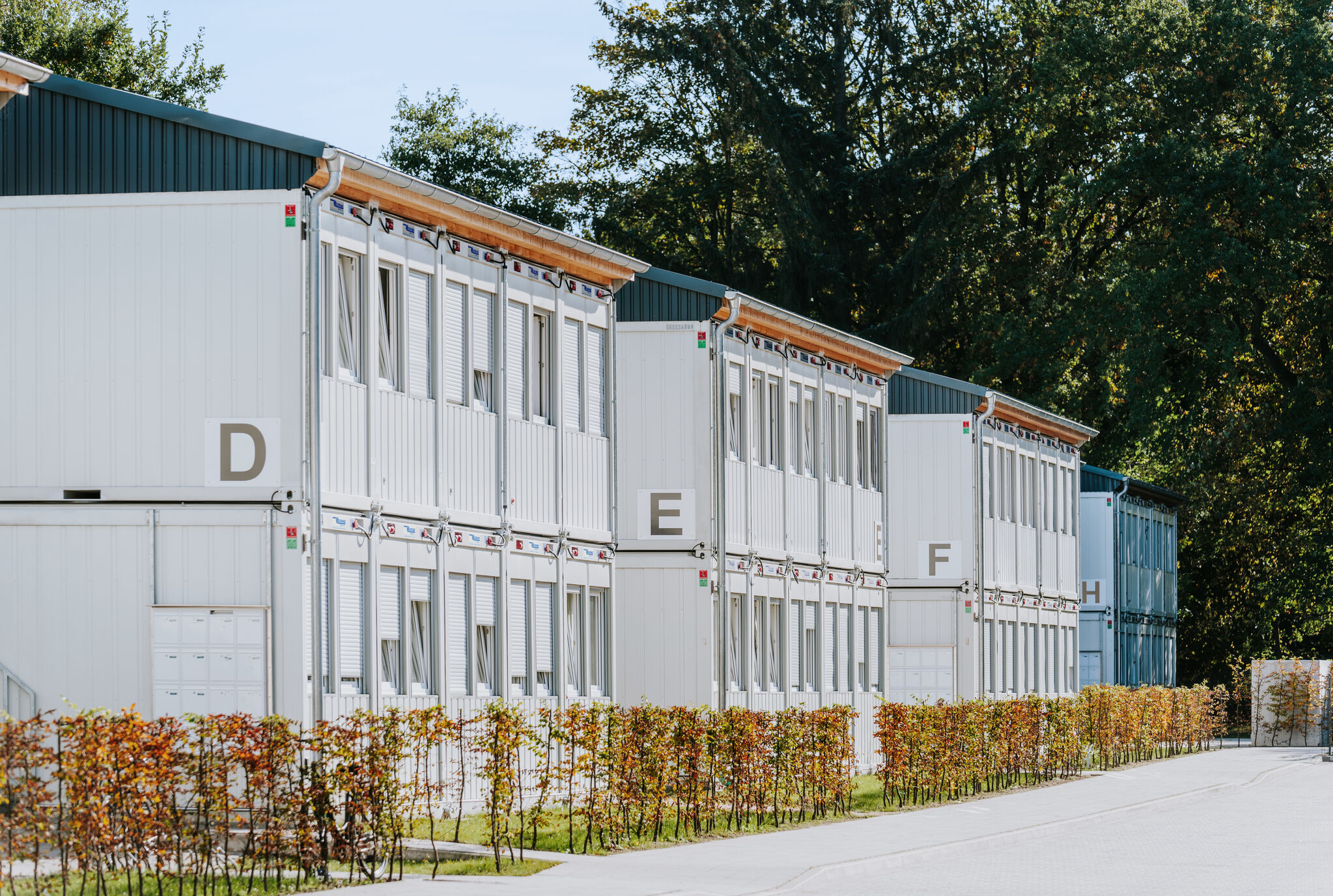
Not all military modular infrastructure is expeditionary. There is substantial and growing demand for permanent and semi-permanent modular buildings on established military installations: office buildings, barracks, training facilities, administrative centres, and support buildings.
The drivers here are different from the expeditionary case but equally pressing. Active military bases cannot easily tolerate the disruption of a conventional construction site running for 12 to 24 months. Security restrictions limit the number and type of civilian contractors permitted on-site. Budget cycles often favour faster delivery, because funds allocated in one financial year must be committed and spent within defined windows.
What higher-specification modular systems offer
Modular buildings for permanent base use are not the same product as deployable field containers. They require enhanced insulation values for year-round comfort and energy efficiency, fire ratings that meet building regulations (REI30, for example, certifies that a structural element maintains its load-bearing capacity, integrity against flame and hot gas penetration, and thermal insulation for at least 30 minutes), and interior finishes that are durable and appropriate for long-term occupancy.
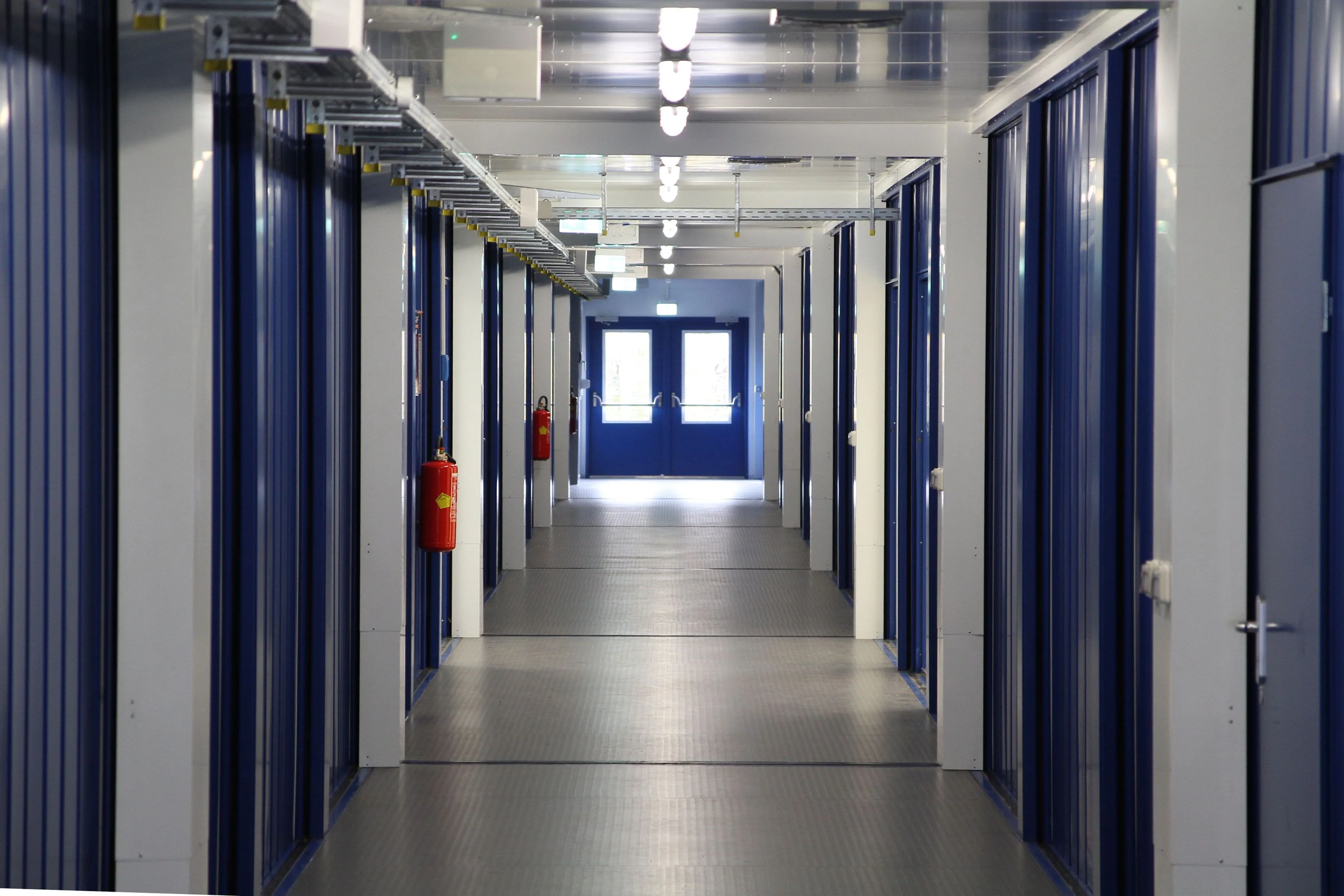
Multi-storey configurations allow density on constrained base footprints, which is common on older European military installations where expansion land is limited.
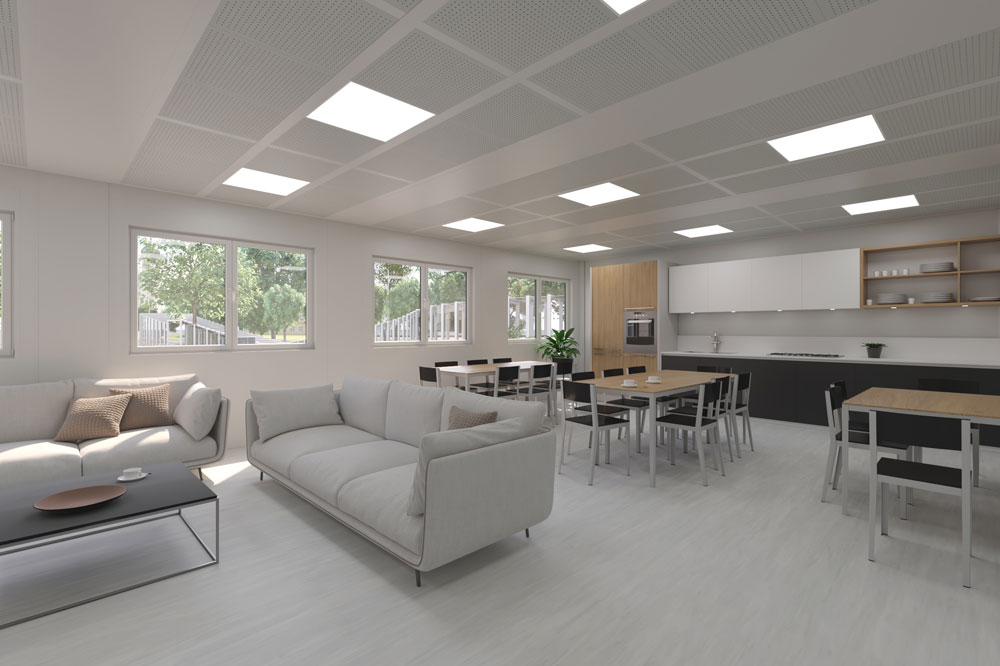
For permanent and semi-permanent base infrastructure, HEPF's Classic Line provides multi-storey-capable modular construction suitable for offices, housing, and administrative buildings. The Plus Line offers enhanced insulation, REI30 fire rating, and premium interior comfort for facilities where long-term quality and public-facing appearance matter. Units can be bought, rented, leased, or bought back, matching the range of military procurement and budget structures.
Specialist Modules for Training, Security, and Mission-Specific Needs
Beyond the standard functional zones, military operations require infrastructure that is highly specialised and, in many cases, unique to defence.
Deployable shooting ranges
A modular shooting range can be scaled in length by adding or removing modules. A six-module configuration delivers a 15-metre operational range and can be deployed within 12 hours. Because it is modular, the range can move between training areas, deploy to a new theatre, or be stored when not in use. This is qualitatively different from a permanent concrete range that serves one location indefinitely.
Urban training environments
Urban trainer systems use rearrangeable modular structures to create scenario-based training environments. Room layouts, corridors, and sight lines can be reconfigured between exercises to prevent pattern-learning and to simulate different building types. The entire structure is relocatable.
Checkpoint modules
Deployable checkpoint modules combine controlled access, protected observation, and surveillance integration in a single structure. They can be configured to threat level and traffic flow requirements, then recovered and redeployed as the operational situation changes.
Signals-secure facilities
For operations requiring acoustic and radio-electronic protection, specialised modules provide shielded environments with integrated HVAC to maintain operability. These serve command, intelligence, and communications functions where electronic emissions or acoustic leakage would compromise the mission.
HEPF's military solutions portfolio includes all of these specialist systems, configured to the specific operational requirement.
One Partner Versus Multi-Supplier Coordination
Military infrastructure projects that rely on multiple suppliers for different module types, transport, installation, and fit-out introduce coordination risk. Under operational time pressure, coordination risk becomes operational risk.
When one supplier provides accommodation, another provides kitchens, a third handles medical modules, a fourth manages transport, and a fifth handles on-site installation, the procuring organisation becomes the de facto systems integrator. Every interface between suppliers is a potential failure point: mismatched dimensions, incompatible utility connections, conflicting delivery schedules, and unclear accountability when something does not work.
A single-partner model reduces this complexity. One point of contact manages the path from requirement through site planning, configuration, production coordination, transport, installation, and handover. Documentation, compliance, and quality assurance run through one channel. Lifecycle support, including service, maintenance, and spare parts for deployed infrastructure, is managed by the same organisation that specified and delivered it.
This matters particularly for defence procurement teams managing framework contracts or multi-year programmes where infrastructure must be deployed, maintained, and eventually recovered across multiple sites and years.
HEPF operates as a single project partner across the full lifecycle: requirements analysis, site planning, configuration, production coordination, transport, installation, and handover, plus ongoing lifecycle support including service centres, maintenance, and spare parts. This is the single-partner model applied to defence: Swiss-led project coordination with a complete modular product portfolio covering every functional zone in a military facility.
What Defence Procurement Teams Should Evaluate
If you are assessing modular infrastructure suppliers for a military requirement, the following criteria will help you distinguish between a container supplier and a genuine infrastructure partner.
Transport efficiency
What is the folding ratio or flat-pack capability of the system? Calculate the total deployment cost per facility, not per unit. A 1:5 folding ratio applied across a 50-module facility produces a fundamentally different transport budget than rigid containers.
Site-level planning capability
Does the supplier plan the full site layout, including utility runs, access, drainage, scalability, and force protection integration? Or do they only deliver individual units to a grid reference and leave site integration to you?
Configuration range
Can one supplier cover accommodation, medical, kitchen, sanitary, storage, command, cold storage, and specialist modules? Or will you need multiple vendors and become your own systems integrator?
Ownership and procurement model
Is rent, lease, purchase, or buyback available? Does the model align with your budget cycle, whether that is annual appropriations, multi-year framework contracts, or CAPEX versus OPEX preferences?
Lifecycle support
Who maintains the infrastructure once deployed? What is the spare parts model? Is there a service centre network, or are you responsible for sourcing maintenance independently?
Recovery and redeployment
Can the facility be recovered, relocated, and redeployed? What is the cost and timeline for recovery compared to initial deployment? Infrastructure that cannot be recovered cost-effectively is not truly modular; it is conventional construction in a different shape.
Environmental and climate performance
Are configurations available for hot, cold, dusty, humid, or remote operating environments? Are autonomous power systems, solar generation, and water treatment available as integrated options rather than bolt-on afterthoughts?
The answers to these questions will separate suppliers who sell containers from partners who deliver military infrastructure.

Book a free consultation
Open, non-binding and tailored to your project.